

In Music & Politics: Self-Scoring As Neoliberal Self-Care in the Early Films of Jim Jarmusch
On the political work of personal music.
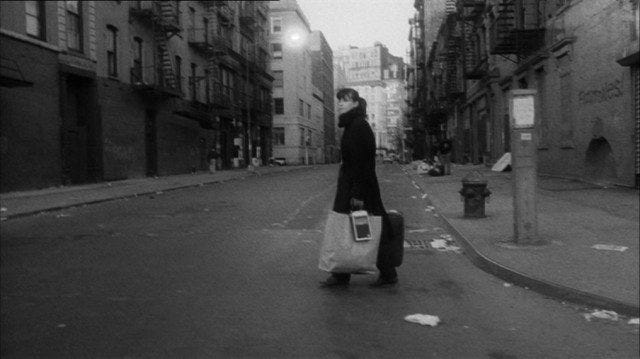
Within the first five minutes of Jim Jarmusch’s Stranger Than Paradise (1984), Eva puts on music. Prior to this, we’ve seen her arrive in New York City from her native Hungary and learned she is headed to her cousin Willie’s apartment. Cut to a barren sidewalk and footsteps on concrete, heard before visualized. Eva walks into the still frame, pausing to retrieve a portable tape player from her bag to play the song that we will eventually understand to be, in some way, hers: “I Put a Spell on You” by Screamin’ Jay Hawkins. She resumes walking, unassumingly traversing the desolate city streets. Holding the tape player at her side, she observes cars in various states of disrepair, passersby, and shuttered storefronts while Hawkins’ gravelly vocalizations continue (Figure 1). The music fades out with the take, and the next shot sees Eva arriving at Willie’s: a dilapidated three-story building on an unremarkable corner…[continue reading in Music & Politics]